
If you look at the long term history regarding the popularity of WordPress themes you will quickly find that most of the popular themes have many templates to use when building a website. The popularity of the theme is specifically because it comes with a bunch of templates.
But why hire a web designer if all they know how to do is “fill in the blanks”. Fill-in-the-blank websites tend to have big problems.
Problems with WordPress Template Websites
First, if a web designer is using a template they should charge less and disclose that they are using a template. BUT, that is rarely the case. Typically the designer builds it fast but doesn’t deliver it right away. And you get charged full price for an inferior product. If the object of building a website with a template is to build it fast there are big drawbacks:
SEO is Typically Ignored
We have worked on hundreds of WordPress websites and out of those hundreds have only seen a few with proper SEO.
- Alternative text
- Heading hierarchy
- Good quality textual content
- etc.
The Templates Aren’t Accessible
ADA compliance is very real today. We build every website to be ADA compliant because we believe it is the right thing to do. To remediate an existing website is so time consuming we typically recommend rebuilding it. So avoid starting off on the wrong foot by not using templates at all.
The Website Isn’t Sustainable
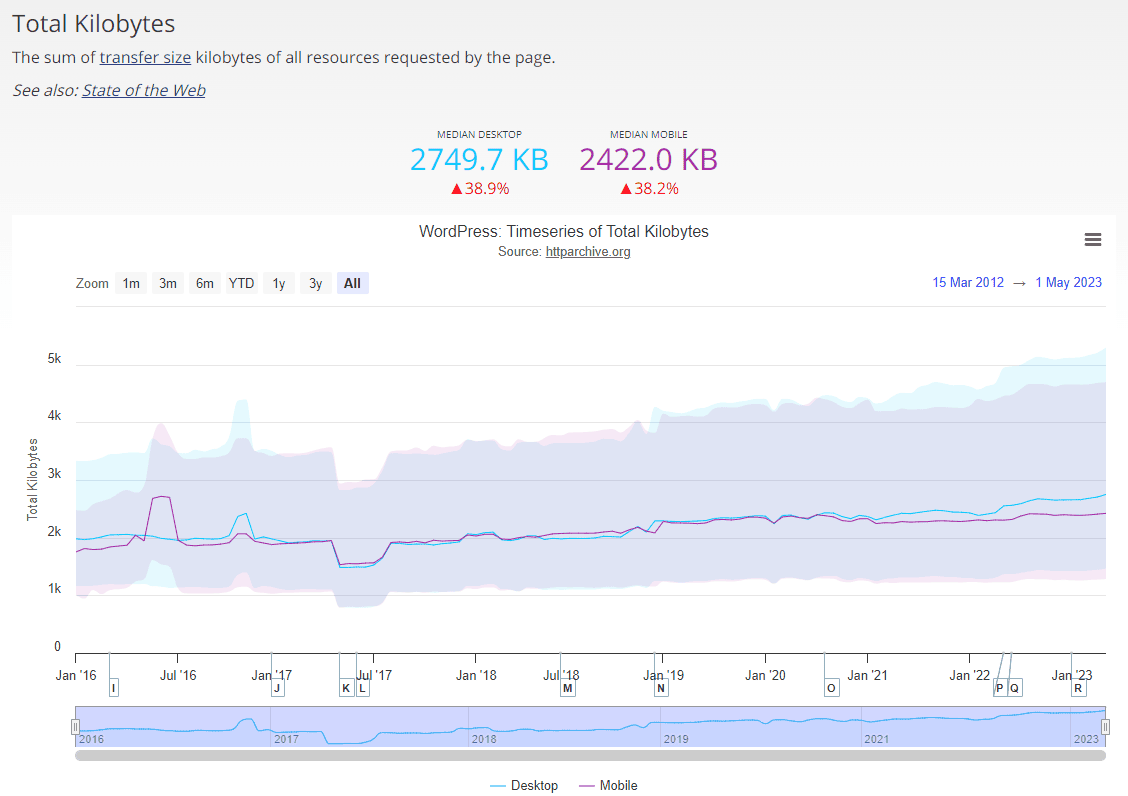
Today, there are very few web developers who are seriously considering sustainability. The median transfer size (Page Weight or the size of all files downloaded when you open a webpage) has increased over 38% on both desktop and mobile devices. Most websites today are above 2MB (2000 kilobytes) in Page Weight. WP Tech Guru websites are so lean they are below the shaded area on the image below which is just above 1MB. Our websites are typically under 500k in transfer size.
Customization is Difficult
- Templates are designed to look good as is. If you want changes things will start coming apart at the seams because the template wasn’t designed to be flexible. One example: When we were asked to change the background on a website (which should be easy), we noticed that the original design had no padding on the content areas. The more we dug into the site the more we realized making a simple change would turn out to be extremely time consuming because we ended up having to write several lines of CSS for various screen sizes to make it look good with a different background.
- Divi theme and Elementor are both drag and drop editors which are considered easy to use, but if a website was built with them the site likely has no design “standards”. So often new elements have to have margins set to match the rest of the website’s look and feel. This is easy but very time consuming if you make a lot of changes to your website.
Outdated Templates and Themes
Sometimes a website built with a template is using an outdated theme. If the theme uses the classic editor, Gutenberg, Beaver Builder or even Elementor you can change the theme & keep your content. If the theme uses shortcodes, like Divi theme, you can’t move the content without manually copying & pasting it.
Another problem with outdated themes is outdated PHP code which needs to be updated to support the latest version of PHP.
Finally, with WooCommerce you may have outdated WooCommerce templates.
Choose a Well Supported Theme Instead of Using a Template
A well supported theme can last you for years because it is updated regularly and is flexible because it comes with various layouts and ideally works well with Gutenberg. While it is more time consuming, a website built well in the first place will save time in the long run and can often handle updates for many years without requiring a rebuild. So the time spent up front saves you money in the long run.